Run your own company's books, and file them yourself.
For contractors, consultants and freelancers trading through a limited company. Canny keeps the books through the year and files the VAT return, the company tax return and the Companies House accounts.
Keep up in two minutes a week.
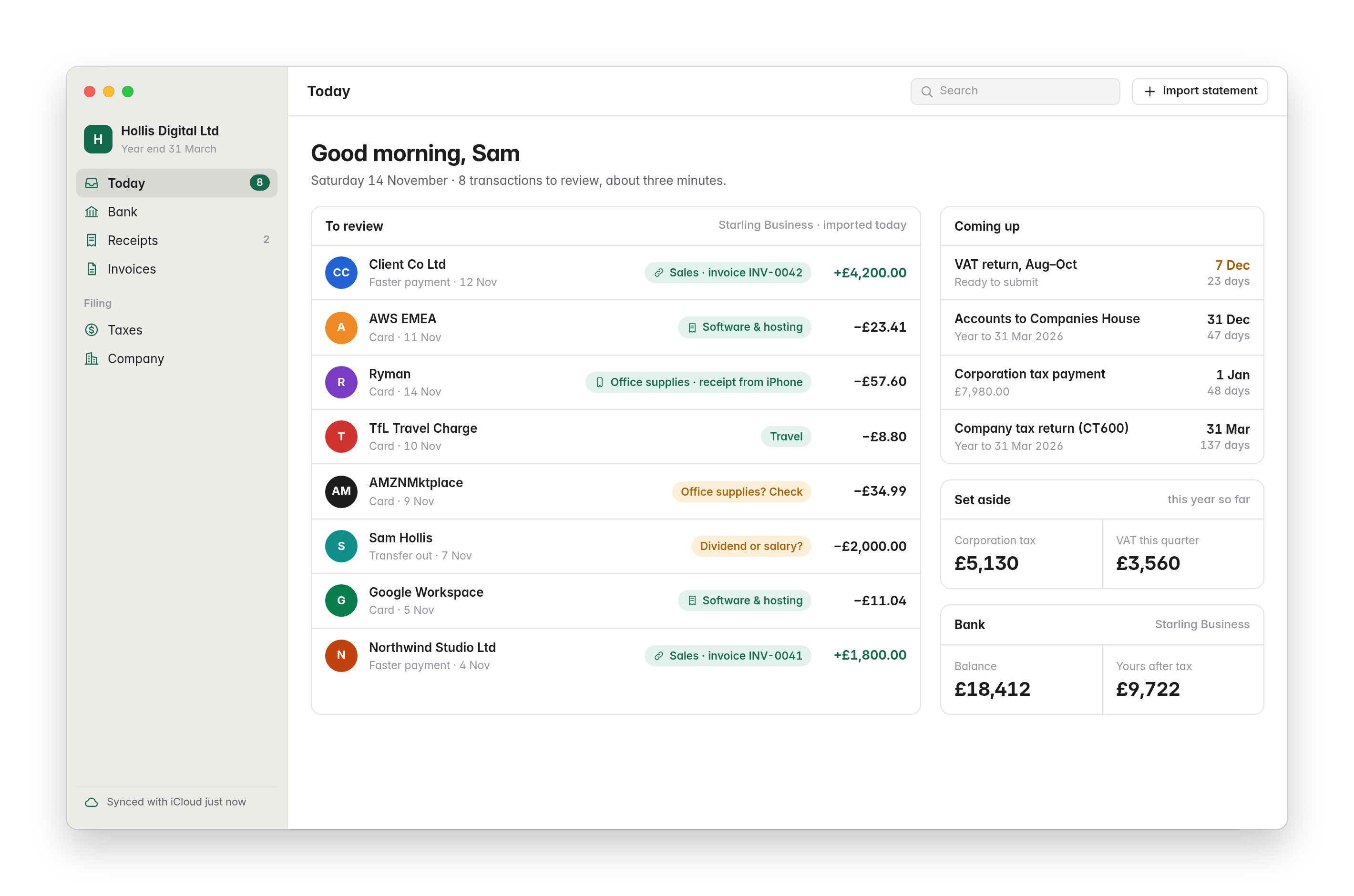
Drop in your bank statement. Canny suggests a category for each line and only asks about the ones it's unsure of. Payments to yourself are flagged so you decide whether each is salary, a dividend or a loan repayment.
- Statements from any UK bank: CSV, OFX or PDF
- Invoices matched to the money arriving
- A running figure for the tax to set aside
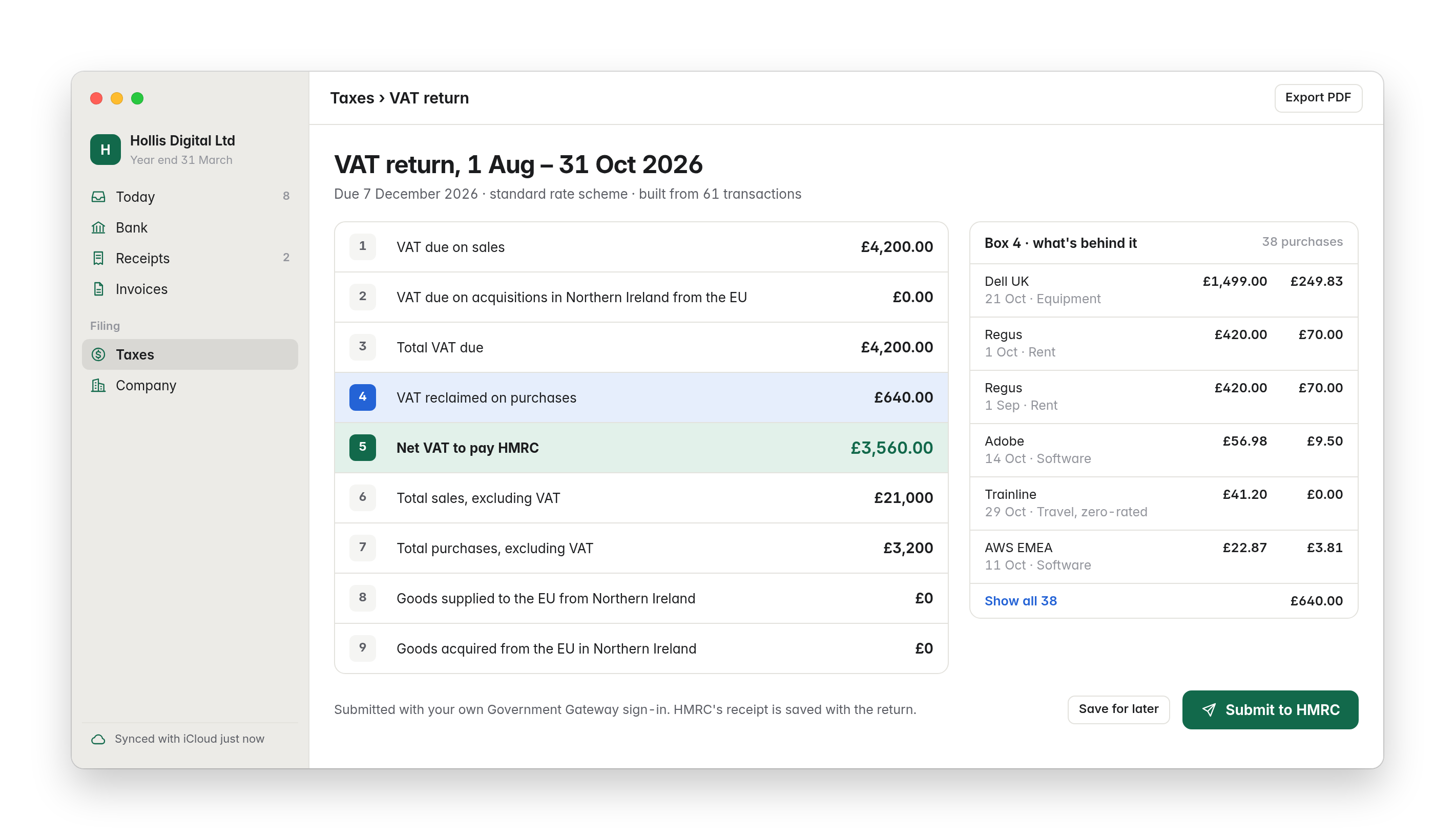
VAT, submitted to HMRC.
If you're VAT registered, the return is built from your books. Open any box to see the transactions behind it, then submit under Making Tax Digital with your own Government Gateway sign-in.
- Standard and flat rate schemes
- HMRC's receipt saved with the return
- Not VAT registered? You'll be warned as you approach the £90,000 threshold
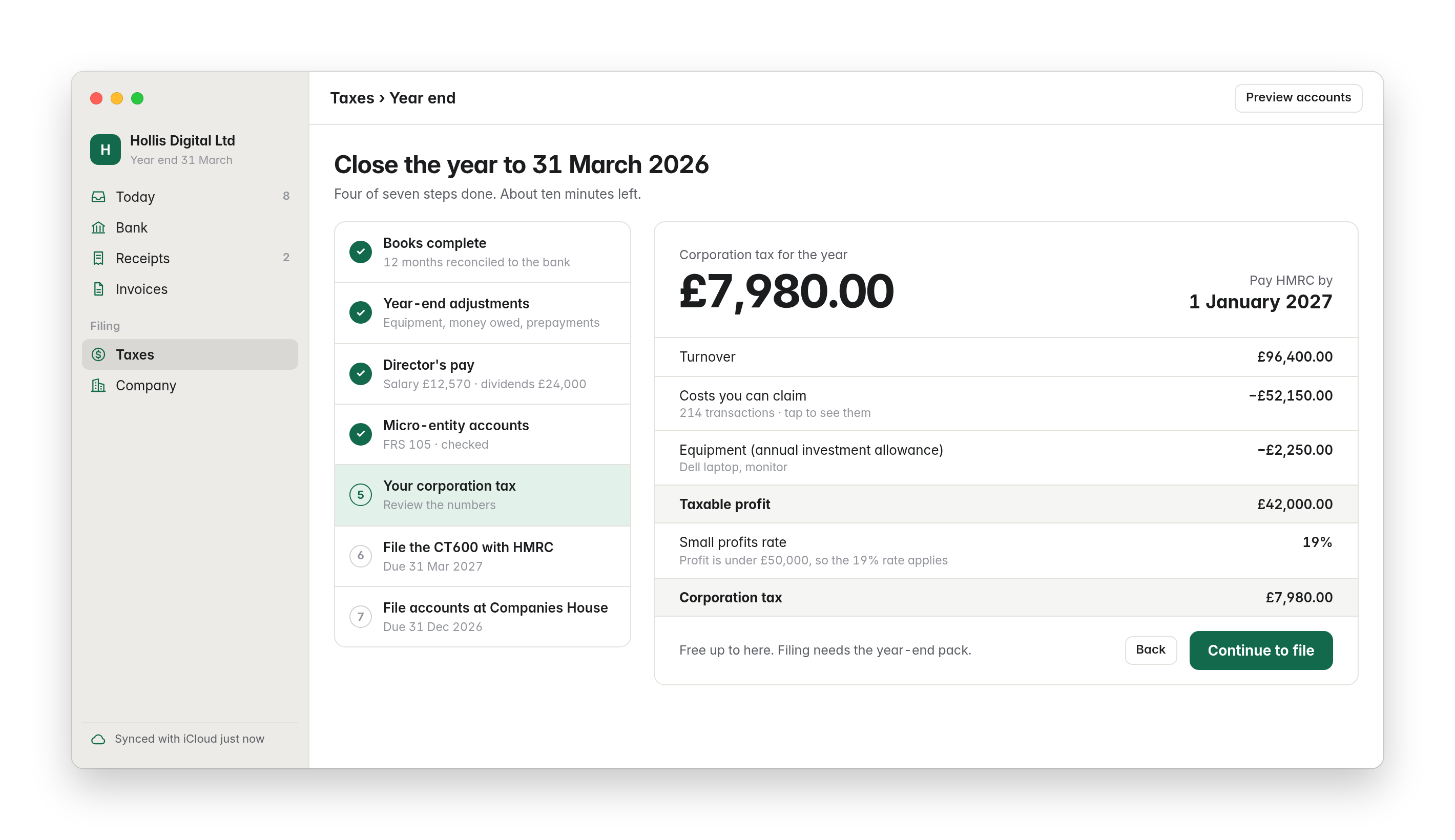
Close the year in one sitting.
A seven-step checklist takes you from finished books to filed returns. You see your corporation tax, and how it was worked out, before you pay for anything.
- Micro-entity accounts (FRS 105) in the iXBRL format both HMRC and Companies House require
- Corporation tax with the small profits rate and marginal relief
- The CT600 to HMRC and the accounts to Companies House
What a small company files, and when.
These are the deadlines for a private limited company after its first year. Canny works them out from your year-end date and reminds you on your Mac and iPhone.
| What | Goes to | Deadline | In Canny |
|---|---|---|---|
| Annual accounts | Companies House | 9 months after your year end | Yes |
| Corporation tax payment | HMRC | 9 months and 1 day after your year end | Amount and reminder; you pay HMRC from your bank |
| Company tax return (CT600) with accounts and computations | HMRC | 12 months after your year end | Yes |
| VAT return, if registered | HMRC | 1 month and 7 days after each quarter | Yes |
| Confirmation statement | Companies House | Within 14 days of your review date, every 12 months | Reminder at first; filing planned |
| Director's Self Assessment, if you need one | HMRC | 31 January | Reminder at first; filing planned next |
| Payroll (PAYE), if you pay a salary | HMRC | On or before each payday | No. Use HMRC's free Basic PAYE Tools |
Sources: GOV.UK on running a limited company, annual accounts and company tax returns. A company's first accounts have a different deadline.
Is it right for your company?
A good fit
- You're the only director, or one of two, and you do the books yourself.
- The company is a micro-entity: two of turnover up to £1 million, balance sheet up to £500,000, up to 10 employees.
- You invoice clients, pay a modest set of costs and pay yourself a salary and dividends.
- Or the company is dormant and just needs its yearly filing.
Not a fit
- You have stock, several employees on payroll or work under the Construction Industry Scheme.
- The company is part of a group, owns property or has overseas income.
- You want someone else to take responsibility for the numbers. That's what an accountant is for.
Pricing for a company
£49 once for the app, which includes bookkeeping and VAT returns. £79 for each year-end you file, or £29 if the company is dormant. A first year costs £128. Compare that with the alternatives →